Audience(s): Tribes, non-tribal government partners, NGO partners
Tribal Stewardship Policy priorities: Ancestral Land Return; Collaboration; Traditional Ecological Knowledge; Strengthening Tribal Partnerships; Funding Stewardship
Objectives: Learn about the benefits of tribal stewardship beyond tribal lands and opportunities to advance tribal stewardship for the benefit of all Californians.
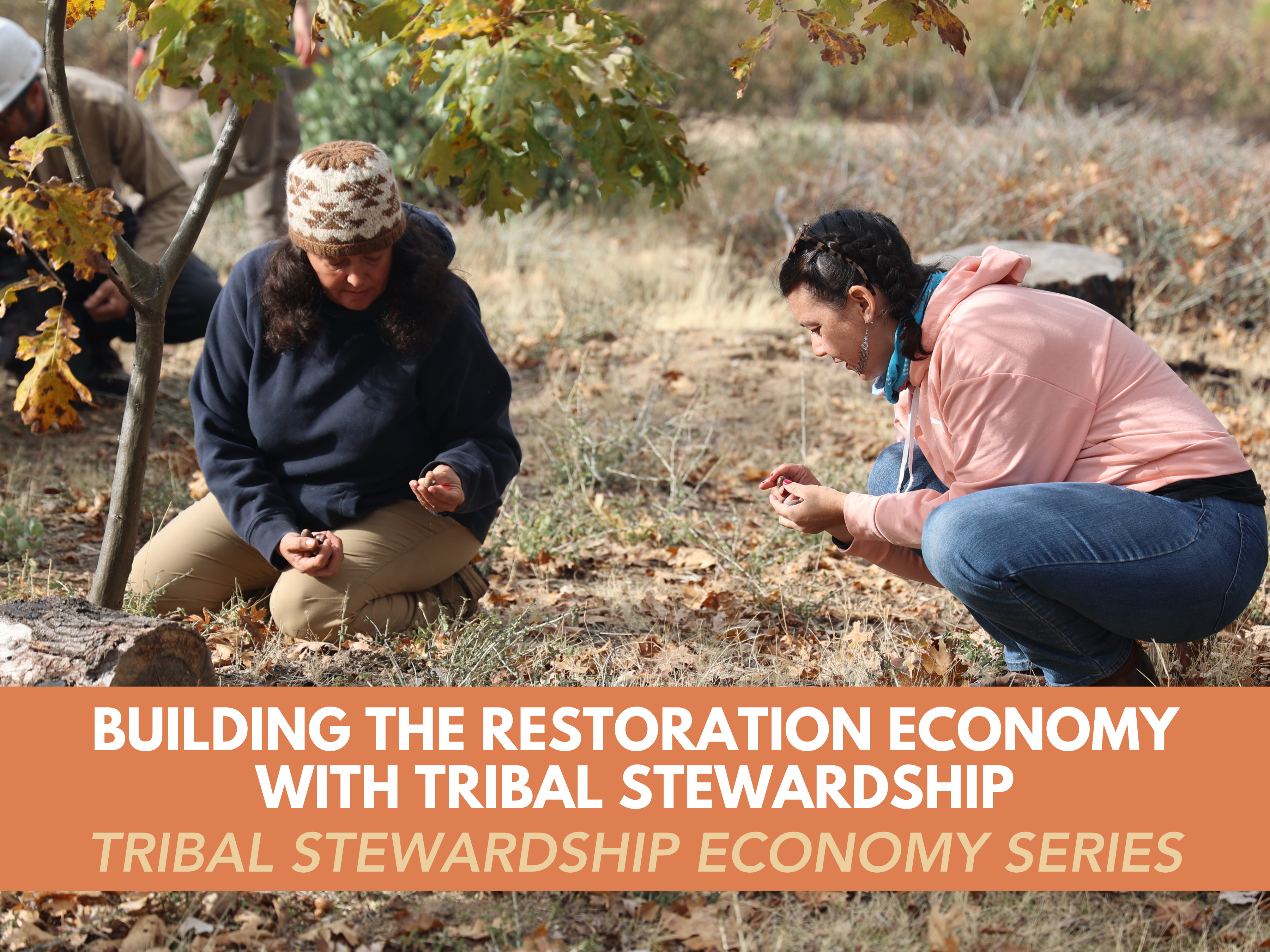
This toolkit entry was developed to support the implementation of California Natural Resources Agency’s Tribal Stewardship Policy and Toolkit. This webinar and associated resources are intended to increase the capacity of tribes, state agencies, and non-tribal entities to advance tribal stewardship, including tribal access, collaboration, and ancestral land return according to the CNRA Tribal Stewardship Policy.
This toolkit entry includes a webinar and resources to deepen your understanding of the tribal stewardship economy, and the mutual goals that California Native American tribes and partners can achieve through collaboration and tribal stewardship.
As the original stewards of the lands and waters in what is now known as California, tribes bring immense and deep knowledge developed since time immemorial. The webinar highlights how tribal stewardship benefits California’s lands, waters, and people. Hear from practitioners and experts about opportunities to advance tribal stewardship throughout the state.
What is the “restoration economy?”
Just like there are economic benefits associated with development, such as building new housing or transportation infrastructure, there are economic benefits associated with the restoration of lands and waters.
Investments in restoration bring benefits for entire communities and regions, creating jobs and contributing to economic and workforce development. Restoration also makes our lands and waters healthier and contributes to improved quality of life.
An April 2026 economic analysis showed that ecological restoration activities in State Parks in Del Norte and Humboldt counties are on track to generate an estimated $140 million in annual economic benefits.
Investing in tribal stewardship brings all of these benefits to tribal communities and their neighbors. In addition to economic benefits, tribal stewardship brings cultural revitalization, reconnection to ancestral lands, waters, food, and medicine.
In turn, all Californians benefit from stewardship by California Native American tribes, who have stewarded California’s lands and waters since time immemorial, and bring deep expertise and Traditional Ecological Knowledge to their stewardship practices.
In the Tribal Stewardship Policy, California committed to advancing tribal stewardship over at least 7.5 million acres of lands and waters. This Toolkit entry dives into how tribal stewardship creates a restoration economy of its own, which benefits tribal communities and all Californians.
In this toolkit entry, you’ll find more information and resources about the economic benefits of Indigenous stewardship, the improved conservation outcomes on lands and waters that are stewarded by Indigenous people. You’ll also find resources and strategies for advancing tribal stewardship on federal lands in partnership with federal agencies.
Watch the webinar:
This webinar features Britnee Nguyen, a postdoctoral scholar at the Native Nations Institute, discussing the report she co-authored, Experts, not Obstacles: Indigenous Conservation Excellence and the Trap of Conservation at any Cost. The webinar also features Rachel Brown, Senior Advisor for Conservation and Strategic Partnerships at Native Americans in Philanthropy and a former Senior Advisor at the Department of the Interior discusses how tribes can use a wide variety of federal agreements including PL 93- 638 agreements to care for federal lands, and the economic benefits this has for tribes and the region. Download the webinar slides here.
Tools
- Tribes can become members of Native Americans in Philanthropy for free—learn more on the NAP Membership Information page.
- A framework for estimating economic impacts of ecological restoration | Thomas et al., Environmental Management (2024)
- “This paper presents accessible methods for quantifying the economic impacts supported by restoration spending and is written to be a guide and toolbox for an interdisciplinary audience of restoration practitioners and economists.”
Resources
- Experts, not Obstacles: Indigenous Conservation Excellence and the Trap of Conservation at any Cost
- Read a brief summary of the report here | This report found that Indigenous conservation practices achieve equal or superior results in biodiversity protection, wildfire management, and sustainable management of natural resources. The researchers found that when Indigenous Nations leading these efforts have greater authority over the land, and more self-determination, the outcomes are even better.
- Explore more research by the Native Nations Institute at University of Arizona
- Explore more research by the Harvard Project on Indigenous Governance and Development
- Indigenous Leadership Initiative
- Indigenous Guardians | Indigenous Leadership Initiative
- U.S. Tribal Stewardship & Guardians | Indigenous Leadership Initiative
- Consolidated report on Indigenous Protected Areas following Social Return on Investment analyses | Social Ventures Australia
- SVA Analysis of Current & Future Value of Indigenous Guardians Work in the NWT | Indigenous Leadership Initiative
- This report found that Indigenous guardians programs create about $2.50 of social, economic, cultural and environmental results for every $1 invested. With support from a national network, researchers projected the value could increase to up to $3.70 for each dollar of investment.
- Building the Tribal Restoration Economy on Federal Public Lands
- Tribal Co-Stewardship and Co-Management of U.S. Ocean and Marine Waters | White Paper for the Biodiversity Funders Group
- This white paper provides background on tribal co-stewardship of federal lands and waters and provides examples. The paper also offers approaches for implementing co-stewardship and co-management in the marine context and provides examples for tribal government approaches and authorities to implement marine co-stewardship.
- Bridges to a New Era: A Report on the Past, Present, and Potential Future of Tribal Co-Management on Federal Public Lands by Monte Mills and Martin Nie
- This report offers a framework for tribal co-management of federal public lands that advances tribal sovereignty and self-determination. It also outlines how PL 93-638 compacts and contracts can advance durable and meaningful co-management on federal public lands.
- “Facilitating Tribal Co-Management of Federal Public Lands” by Kevin Washburn. Wisconsin Law Review, University of Iowa Legal Studies Research Paper No. 2021-45. Volume 2022, Issue 2, 2022.
- Check out the Sovereign to Sovereign Cooperative Agreements Repository to find legal background and examples of agreements between tribes and the federal government.
- Learn more about using Self-Governance Compacts and Funding Agreements to advance co-management here (PL 93-638)
- Learn more how the Good Neighbor Authority has been expanded through the EXPLORE Act here: National Policy Summary Analysis - Expansion of Good Neighbor Authority in the EXPLORE Act
- Read the EXPLORE Act here: COMPS-18096.pdf
- For more information on co-stewardship opportunities with the Department of Interior can be found here: Co-stewardship | U.S. Department of the Interior
- More information on partnership opportunities with US Department of Agriculture and US Forest Service
- Tribal Co-Stewardship and Co-Management of U.S. Ocean and Marine Waters | White Paper for the Biodiversity Funders Group
- Learn more about the “restoration economy”
- New Analysis Shows Ecological Restoration in California’s State Parks Creates Good-Paying Careers | California State Parks (2026)
- A study found restoration projects generate hundreds of jobs and more than $140 million in regional economic benefit each year
- New Analysis Shows Ecological Restoration in California’s State Parks Creates Good-Paying Careers | California State Parks (2026)

