Audience(s): Tribes
Tribal Stewardship Policy Priorities: Ancestral Land Return, Caring for the Land, Traditional Ecological Knowledge, Navigating State Agencies
Objectives: This toolkit entry includes resources for tribes to Cut Green Tape for tribal restoration projects, including resources for navigating the various pathways and exemplar projects.
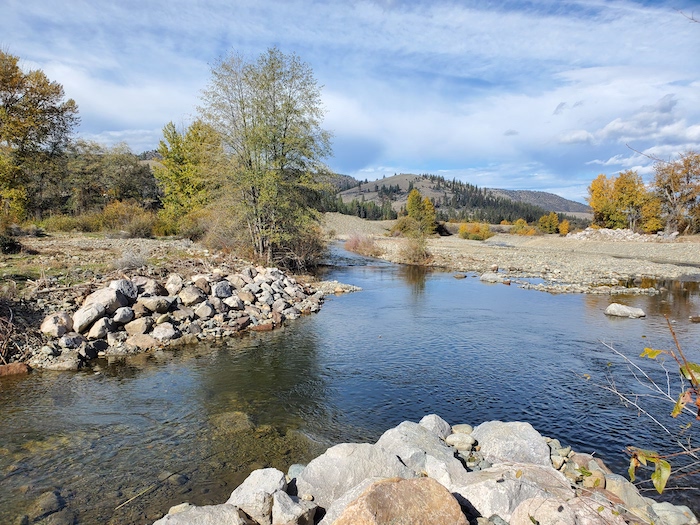
The confluence of Sugar Creek with the main stem Scott River. Credit: Yurok Tribe Fisheries Department, L. Hubbard
This toolkit entry was developed to support the implementation of California Natural Resources Agency’s Tribal Stewardship Policy and Toolkit. The associated tools are intended to increase the capacity of tribes, state agencies, and non-tribal entities to advance tribal stewardship, including tribal access, collaboration, and ancestral land return according to the CNRA Tribal Stewardship Policy.
This entry includes a webinar overviewing the Cutting Green Tape initiative for a tribal audience. Agency staff and tribal representatives discuss how Cutting Green Tape can be helpful to tribes and will overview of available resources for navigating restoration permitting pathways. Tribal representatives describe their experiences utilizing these tools to implement restoration projects.
The webinar and toolkit entry highlight two projects in particular—the Yurok Tribe’s Scott River Restoration Farmers Ditch project, and the Colfax-Todds Valley Consolidated Tribe’s Intertribal Ecocultural Restoration Crew project.
Watch the webinar
Tools
- Cutting Green Tape for Tribal Stewardship: Takeaways from the December 2025 Webinar
- Sustainable Conservation Accelerating Restoration Website: This helps project practitioners identify what permits they need and what streamlining is available for a particular project. For any given project there are often multiple pathways to streamline and this website and tool can help people sort through that.
- Sustainable Conservation offers free permitting strategy advice and technical assistance—find more information here.
- CDFW Cutting the Green Tape Website: Review this website for permitting resources, grant opportunities, and announcements.
- CDFW Cutting Green Tape Contacts: Tribal project proponents should reach out to the appropriate regional contact, and if there is no one listed in their area, then contact the general CGT Program Inbox.
- California Natural Diversity Database can be helpful to tribes in preparing baseline data needed for grant applications and project planning.
Resources
- Yurok Tribe Scott River Restoration Farmer’s Ditch Project
- Restoration Round-Up: A Scott River Restoration Story by Accelerating Restoration
- This webpage describes the project in greater detail, and includes a webinar as well as more information on the expedited permitting pathways used to complete the project.
- Press Release: Yurok Tribe, Farmers Ditch Company, and California Trout Break Ground on Scott River Restoration Project
- News: Scott River Restoration Project Brings Together CalTrout, Yurok Tribe, & Farmer’s Ditch Company
- Restoration Round-Up: A Scott River Restoration Story by Accelerating Restoration
- Colfax-Todds Valley Consolidated Tribe Intertribal Ecocultural Restoration Crew project
- Related Cutting Green Tape Webinars:
- Regulatory Strategies to Advance Restoration: Multi-benefit Permitting – This webinar, held on March 27th, 2025 examines the most efficient and effective ways to advance environmental restoration projects. Part of a series on Regulatory Strategies to Advance Restoration, this webinar highlights a variety of innovative regulatory tools that have emerged to accelerate the pace and scale of habitat restoration and forest resilience projects.
- Regulatory Strategies to Advance Restoration: CEQA Pathways - On January 22, 2025, CNRA hosted a webinar about Cutting Green Tape regulatory efficiencies to increase the pace and scale of environmental restoration projects. This webinar highlighted key pathways for California Environmental Quality Act compliance including the Statutory Exemption for Restoration Projects, as well as the Statewide Restoration General Order and accompanying Programmatic Environmental Impact Report.
- The Race to Restore Nature: Cutting the Green Tape for California's Environment December– December 4th, 2025, this Speaker Series Webinar overviews Cutting Green Tape, which is focused on improving interagency coordination, partnerships and agency processes and policies to allow ecological restoration and stewardship to occur more quickly, simply, and cost-effectively. Numerous state and federal agencies and non-government partners have been working to break down barriers within the permitting and regulatory fields to increase the pace and scale of restoration work across the state.
- Faster and Better: Restoring our Environment to Protect People & Nature (Secretary Speaker Series) — In this webinar, Secretary Crowfoot and Agency staff evaluate our progress “Cutting Green Tape” to deliver environmental projects and discuss what comes next.


