Published Date:
State’s first-ever Tribal Stewardship Policy establishes statewide framework for tribal access, collaboration, and ancestral land return
SACRAMENTO, Calif. – The California Natural Resources Agency (CNRA) today launched the state’s first-ever Tribal Stewardship Policy, establishing a statewide goal of expanding tribal stewardship over at least 7.5 million acres of lands and coastal waters in California. As the original stewards of the lands and waters in California, tribes have exceptional expertise managing our state’s environment and natural resources.
The Policy sets clear standards to institutionalize meaningful and durable tribal-state partnerships and advance tribal stewardship through tribal access, collaboration, and ancestral land return – a historic milestone in the state’s efforts to transform its work with California Native American tribes.
For generations, state policies directed state agencies to resist and ignore tribal stewardship, undervalue Traditional Ecological Knowledge, and criminalize traditional practices. The legacy of these policies caused lasting harm to tribal and non-tribal communities alike and weakened the health of California’s lands and waters. Today, tribal stewardship and traditional ecological knowledge practices stand as proven approaches to addressing urgent environmental challenges, including catastrophic wildfire, salmon recovery, biodiversity loss, and coastal resilience.
“This Policy reflects a shift toward real partnership between tribes and California and recognizes our role as original stewards of these lands. For the Iipay Nation of Santa Ysabel, we worked closely with the California Natural Resources Agency through their Tribal Nature Based Solutions grant program to re-acquire over 1,000 acres of land ancestral territory, support cultural revitalization, and restore balance to ecosystems that have sustained our people for generations,” said Chairman Kevin Osuna, Iipay Nation of Santa Ysabel. “Policies like this confirm our enduring relationship with the land while building a healthier future for all Californians.”
"When it comes to water, land, and all the natural resources that Tribal People have depended upon since time immemorial, it's very difficult to quantify that or put into words the importance and value of it all. Having an approved Tribal Stewardship Policy that supports meaningful and durable tribal stewardship is a major victory for Tribal Members everywhere as well as for our partners representing the State of California and elsewhere,” said Chairman Joe Davis of the Hoopa Valley Tribe. “We are grateful to everyone who has put in the hard work necessary to bring this important vision to reality."
"Tribal stewardship is not a single action, it is a best practice. Through the return of our ancestral lands, meaningful collaboration and co-management with CNRA, and guaranteed access to the places that hold our history and ceremony, we are restoring our responsibility to care for the land as our ancestors intended,” said Chairwoman Erica M. Pinto of the Jamul Indian Village of California, one of the 13 tribes of the Kumeyaay Nation. “These pathways honor our sovereignty, strengthen our partnerships, and ensure that future generations inherit a landscape that is healthy in spirit and in practice."
“We’ve been stewards of the land for thousands of years, managing and living off of the biodiverse ecosystems we purposefully stewarded… A lot of different groups in California have a shared vision for preserving what’s here.” Mechoopda Indian Tribe of Chico Rancheria Councilmember He-Lo.
“Tribal stewardship and traditional land management practices benefit all Californians,” said California Natural Resources Secretary Wade Crowfoot. “When nature thrives, we all thrive. This policy also confronts the harms perpetrated by our government that disrupted tribal relationships to the land. In institutionalizing tribal stewardship with our agency, we begin a new era of partnership with tribes.”
Tribal stewardship over at least 7.5 million acres of land and water is one step toward correcting these historic harms committed against tribes by the state. In 1852, the California Legislature intervened to stop the U.S. Senate from ratifying 18 treaties promising approximately 7.5 million acres as permanent tribal homelands. The failure to ratify these treaties remained hidden for decades, even as tribes upheld their commitments.
California has taken significant steps toward understanding and addressing historical wrongs in the spirit of truth and healing. As of March 2026, CNRA and its departments, conservancies, and commissions and agencies from across the state have supported, through funding or other opportunities, the return of approximately 103,000 acres of land back to California Native American tribes, with more acres to be returned soon. Additionally, State Parks has entered into 15 memoranda of understanding (MOU) and Joint Powers Agreements with California Native American tribes for tribal access and collaboration over 89 Parks Units covering approximately 939,000 acres of land. The California Department of Fish and Wildlife and many other CNRA departments are actively developing additional tribal access and collaboration agreements with tribes across California. CNRA, through its Tribal Nature Based Solutions grant program and Climate Bond funding is seeking applications from tribes for their ancestral land return and other tribally-led nature-based solutions projects.
To continue this work, the Tribal Stewardship Policy provides a framework for all CNRA departments, conservancies, commissions, boards, and many other non-tribal partners to advance tribal stewardship. The Policy is supported by a companion toolkit containing training materials, templates, webinars, and technical resources designed for tribes, agency staff, and partners working to advance access, collaboration, and land return.
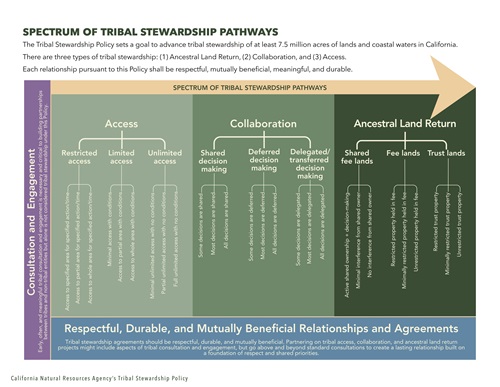
The Tribal Stewardship Policy will better support tribes and sustainable tribal partnerships through:
• Durable and consistent access to ancestral lands and coastal waters for cultural use, stewardship, and general visitation.
• Clear recognition of tribes as land and water stewards and decision-making partners.
• Stronger pathways for ancestral land return and long-term ownership.
• Reduced administrative barriers through consistent standards across state agencies.
• Formal recognition of Traditional Ecological Knowledge as essential to land and water management.
• Practical tools and guidance supporting implementation and partnership building.
Tribal leaders emphasized the importance of the policy in restoring stewardship, strengthening partnerships, and supporting cultural and ecological resilience.
“The Policy firmly acknowledges California’s role in historic wrongs and charts a vision for the future grounded in the spirit of truth and healing. The policy and toolkit provide non-tribal governments and our many partners with goals and training resources needed to institutionalize durable and meaningful relationships with tribes in advancing tribal access, collaboration, and ancestral land return,” said CNRA Deputy Secretary for Tribal Affairs Geneva E.B. Thompson. “By advancing tribal stewardship, we repair our relationships with tribes and improve the health of California’s lands and waters for all Californians.”
While this is an important step, CNRA acknowledges additional work remains to fully address historic harms and rebuild trust. CNRA views this Policy as a key step to building lasting partnerships grounded in mutual respect with tribes. It complements other initiatives underway, including the Tribal Nature-Based Solutions grant program that supports ancestral land return and the Agency’s Tribal Consultation Policy and Best Practices.
For more information and to read the Tribal Stewardship Policy and explore the Toolkit, please visit https://resources.ca.gov/Initiatives/Tribalaffairs/TribalStewardshipPolicyAndToolkit.