
Feather River Gravel Project Supports Chinook Salmon and Steelhead Spawning
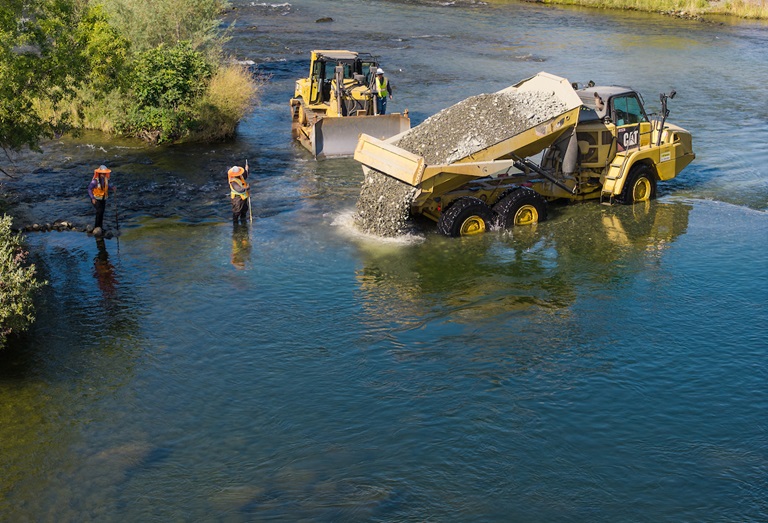
Throughout California’s Central Valley, Chinook salmon and steelhead trout migrate between the ocean and inland rivers to spawn during their lifecycles. Ahead of the fall spawning season, DWR completed a salmonid habitat improvement project in the low-flow channel of the Feather River in Oroville, placing approximately 8,000 cubic yards of spawning gravel between the Table Mountain Bridge and Bedrock Park.
“Oroville Dam blocks the upstream passage of some fish to their natural spawning habitat and prevents the migration of gravel that would naturally flow downstream,” said Kassie Henley, senior environmental scientist with DWR’s Feather River program. “Through gravel restoration projects, DWR supports fish that use the Feather River for this critical phase of their lives. The gravel is placed in July and August ahead of when Chinook salmon and steelhead spawn to avoid impacts to eggs.”
Female Chinook salmon use their tails to dig redds, clusters of bright red fertilized eggs, which are buried in gravel beds. The eggs then hatch within the gravel into alevin, the first lifecycle stage of a new salmon. For gravel supplementation projects, DWR selects gravel that is an ideal size for spawning activities. Rocks that are too large are difficult for fish to move, while those that are too small can suffocate the eggs.
DWR scientists routinely evaluate spawning habitat to identify areas that would benefit from gravel supplementation. Since 2014, three other Feather River gravel projects have placed approximately 21,000 cubic yards of gravel to support spawning. These projects have been hugely successful, with staff observing high levels of spawning activity in areas that have been enhanced with new gravel. As Feather River flows increase during the winter and spring, gravel naturally migrates to create new spawning habitat downstream.
Restoring gravel in one of the most heavily utilized spawning areas of the Feather River is a delicate matter. As experts in agricultural drainage and flood protection infrastructure, Reclamation District 1500 was contracted for the project.
“RD 1500 and other reclamation districts in the Sacramento Valley have worked together with agency partners to maintain a strong habitat program,” said Roger Cornwell, general manager of Reclamation District 1500. “We’ve been working on the Sacramento River for over a decade doing gravel injection, gravel shaping, and other habitat projects up near Shasta Dam, which naturally leads us to also supporting projects in the Feather River.”
Gravel restoration projects are just one way DWR and its partners aid Central Valley fish throughout the year. Other efforts include:
- The Feather River Fish Hatchery raises millions of spring- and fall-run Chinook salmon and steelhead smolts and fingerlings each year.
- Fish are tracked through an in-river video monitoring system, providing valuable information on how many adult salmon and steelhead returned from the Pacific Ocean.
- Escapement surveys are used to collect biological information on adult salmon that naturally spawn in the Feather River.
- Drone surveys help scientists evaluate the effectiveness of gravel placements and existing spawning habitat to determine if improvements are needed.
- DWR also collects data on juvenile Chinook salmon and Central Valley steelhead through emigration monitoring with rotary screw traps, beach seine, and visual snorkeling surveys to document habitat use.
Learn more about DWR’s work on the Feather River by visiting the Feather River Program webpage or watching the Best of Feather River series on YouTube.