
Lake Oroville Update - March 13, 2026
A drone view Thermalito Afterbay part of DWR Oroville-Thermalito Complex in Butte County, California. Photo taken on December 03, 2025.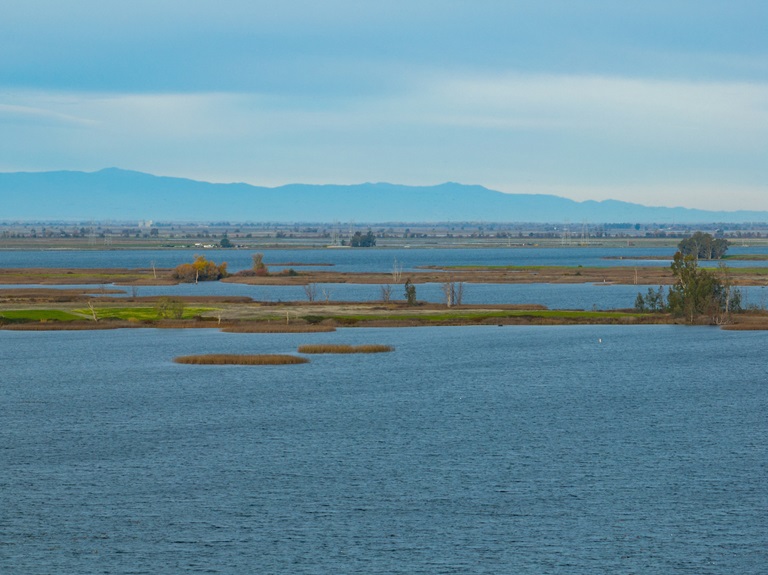
DWR Conserving Water Storage at Lake Oroville
The Department of Water Resources (DWR) reduced water releases from Oroville Dam as dry conditions continue in the Feather River watershed. DWR continues to conserve as much water as possible while meeting federal guidelines for downstream flood protection and state environmental regulations.
Between mid-September and June, DWR is required to operate Lake Oroville for flood control under federal Water Control Manual Guidelines set by the U.S. Army Corps of Engineers. These federal regulations establish a storage space that is reserved to capture inflows from rain and snowmelt, while protecting downstream communities from damaging flood events through coordinated releases. To maintain this storage space, DWR conducts flood protection releases from Lake Oroville. Some water released from Oroville for flood control is captured downstream for beneficial uses by local landowners, communities, and the State Water Project. Releases from Oroville Dam also support Feather River habitat for salmon, steelhead, sturgeon, and other river species.
DWR coordinates releases to the Feather River closely with the U.S. Army Corps of Engineers and other downstream water operators. DWR advises Feather River recreation users to remain alert as river flows are expected to be swift and cold and may change based on projected weather forecasts.
The information below reflects current reservoir level estimates. Forecasts can change quickly and may affect the estimates provided.
- Current Oroville Reservoir Level: 871 feet elevation
- Current Storage: 88 percent of capacity
- Total Releases to the Feather River: 7,000 cubic feet per second (cfs); decreasing to 6,500 cfs on Saturday, March 14
The Lake Oroville reservoir is the largest storage facility in the State Water Project, providing flood protection while supporting environmental and water delivery needs to 27 million Californians. DWR continues to monitor lake levels, weather forecasts, and mountain snow levels to optimize water storage and allow for carryover storage into the following year.
Partial Thermalito Afterbay Closure
Speedboat time trials are returning to the Thermalito Afterbay March 14-15. The event requires the closure of the southern portion of the Afterbay (south of Highway 162), the Monument Hill boat ramp, and the Larkin Road cartop boat launch on Saturday and Sunday. The Wilbur Road boat ramp remains closed to trailered launching due to DWR’s invasive mussel prevention program. Watercraft launching from this site must be hand launched. In addition, areas north of Hwy 162 will remain open for public use during the boating event.
The event is hosted by the Northern California Outboard Association and East Bay Boat Club and features a mile-long course. Time trial events are expected Saturday and Sunday from 8 a.m. to 5 p.m. depending on weather and water conditions. More information about the event can be found on the American Power Boat Association webpage.
Road Closure for Tree Removal
DWR and its partners at the California Conservation Corps (CCC) and the Butte County Sheriff’s Office are closing a portion of Oro Dam Blvd. East between Canyon Drive and Oro Powerhouse Road for hazard tree removal. A full road closure will be in effect Monday through Thursday between 7 a.m. and 4 p.m. March 16-19 and March 23-26. DWR is taking advantage of the closure to remove large hazard trees and perform routine fuel load reduction activities to minimize fire risk in areas surrounding Lake Oroville.
DWR’s Fuel Load Management Plan is dedicated to reducing wildfire risk, enhancing public safety, and improving forest health around Lake Oroville. During vegetation management activities some trails within the Lake Oroville State Recreation Area may be intermittently closed. Trail users should use caution in active work areas and follow all posted signage.
Golden Mussel Inspection Program
DWR has moved its invasive mussel inspection/decontamination facilities at the North Thermalito Forebay to the paved RV parking lot near the entrance. Watercraft owners should turn right once past the main entrance. Signage is posted to help direct traffic. More details about DWR’s mussel inspection program are available at water.ca.gov/mussels.
Watercraft Inspection Location/Decontamination Services
North Thermalito Forebay at Garden Drive and HWY 70 in Oroville
Hours of operation: Daily from 8:30 a.m. to 5:30 p.m.
Sealed Vessel Launching
Lake Oroville
Ramp hours: Daily from 7:30 a.m. to 9 p.m.
- Spillway
- Bidwell Canyon
Ramp hours: Daily from 5 a.m. to 9 p.m.
- Lime Saddle
- Loafer Creek/Loafer Point
Thermalito Afterbay
Ramp hours: Daily from 1.5 hours before sunrise to 1 hour after sunset
- Monument Hill
Thermalito Forebay
Ramp Hours: Daily from 8 a.m. to sunset
- North Forebay (Non-motorized vessels only)
Feather River Fish Monitoring Station
DWR resumed operations of the Feather River fish monitoring station on March 4, 2026 to capture the return of spring-run Chinook salmon. Monitoring was temporarily suspended at the end of December 2025 due to anticipated high flows in the Feather River. Upstream migrating fish totals between March 4-7, 2026 are:
- Spring-run Chinook salmon: 1
- Steelhead: 2
- To see previous year data, visit CalFish.org.
Current Lake Operations
Lake Oroville is at 871 feet elevation and storage is approximately 3 million acre-feet (MAF), which is 88 percent of its total capacity and 129 percent of the historical average.
Feather River flows are at 650 cfs through the City of Oroville with releases from the Thermalito Afterbay River Outlet at 6,350 cfs for a total Feather River release of 7,000 cfs downstream. Releases from the Outlet will reduce to 5,850 cfs on March 14 for a total Feather River release of 6,500 cfs. DWR continues to assess Feather River releases daily.
The public can track precipitation, snow, reservoir levels, and more at the California Data Exchange Center. The Lake Oroville gage station is identified as “ORO.”
All data as of 11:59 p.m. on 3/12/2026.