
Detecting the Delta’s Inhabitants Through Their DNA Fingerprint
California Department of Water Resources Assistant Estuarine Ecologist Kristina Nguyen collects samples from the Delta as part of the DWR Multitrophic-Level Metabarcoding (MTLM) program.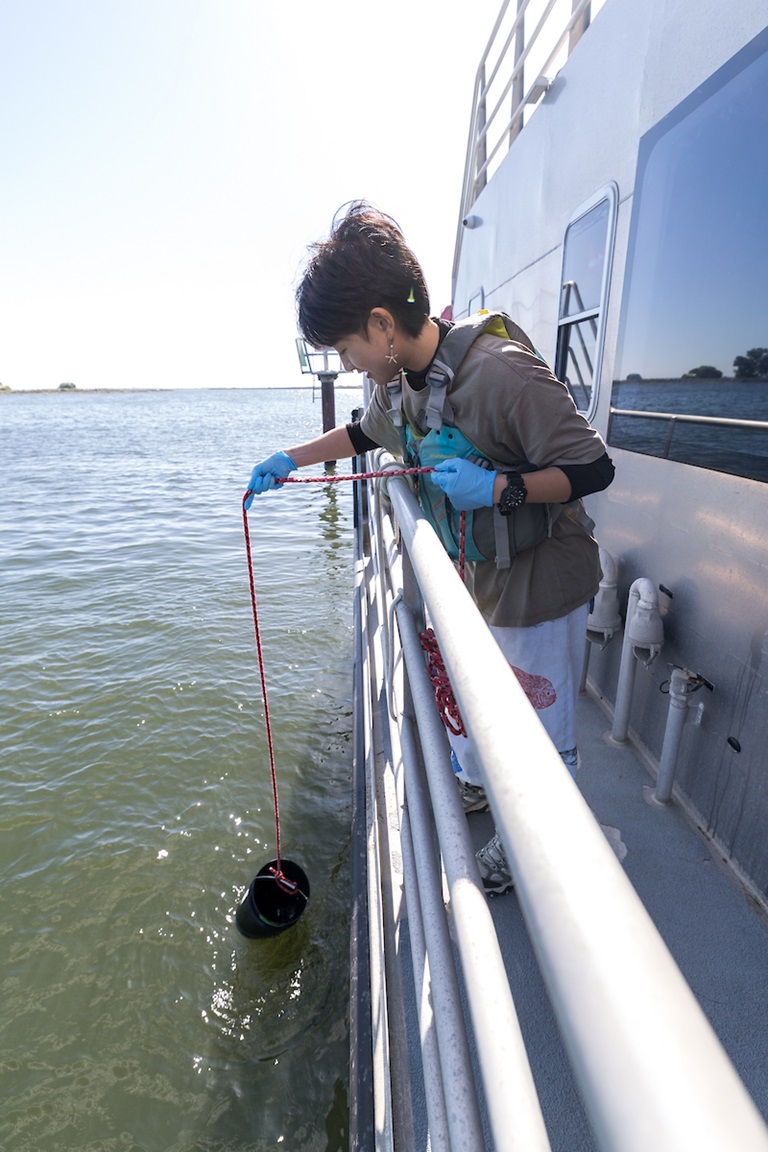
Finding the Delta’s most elusive residents means digging deep down into the microscopic traces they leave behind.
DWR scientists are doing just that by tapping into DNA, the cellular material that contains the building blocks of life and is found in all organisms. Every living organism sheds environmental DNA (eDNA) into its surroundings through skin cells, waste, mucus, or other biological material.
Using a process known as metabarcoding, DWR scientists analyze tiny traces of genetic material left behind by plants and animals to generate a detailed snapshot of an ecosystem and the species that inhabit it. Researchers collect environmental DNA (eDNA) samples from air, soil, and water, then use advanced genetic techniques to identify the organisms present.
Because eDNA can reveal a species’ presence without the need to physically capture, handle, or even observe it, metabarcoding provides a powerful, non-invasive tool for monitoring biodiversity and tracking ecosystem health. DWR scientists analyze those genetic traces to create an instant snapshot of the ecosystem and the species living within it.
Metabarcoding analyzes small genetic sequences in eDNA samples and compares them to reference databases to determine which species are present in a sample. In an environment as varied as the Delta, a single water sample can determine the presence of a host of species, big and small.
“The barcode is one small genetic sequence, often a ‘housekeeping gene’ common to all organisms,” said Daphne Gille, environmental program manager with DWR. “By comparing the barcode sequences we get in our sample to genetic reference databases, we can tell which species, from plankton all the way up to fish, were present at a particular time.”
Researchers say the technology has enormous potential for ecosystem monitoring, climate adaptation, and rapid-response water management. While metabarcoding is still evolving as a direct management tool, advances such as automated sampling, handheld genetic tools, and near real-time data processing could soon make it a standard method for tracking environmental change.
“Compared to traditional sampling, metabarcoding is faster, more sensitive, and often more cost-effective,” Gille said. “It improves detection of rare or hard-to-find species such as Delta smelt, Longfin smelt, and non-native, invasive nutria while also providing broader biodiversity data.”
Scientists say metabarcoding is also safer and less invasive than traditional capture methods. It can serve as a valuable backup when physical sampling is not possible because of unsafe weather or field conditions. The technology is increasingly being used to monitor biodiversity in rivers, wetlands, and reservoirs, while supporting ecosystem health assessments, and improving early detection of invasive species.
Still, researchers caution that metabarcoding works best alongside traditional monitoring methods because of inherent limitations associated with eDNA. Because eDNA cannot determine whether an organism is alive or dead, its life stage, or exactly when it passed through an area, scientists pair genetic monitoring with physical sampling and visual identification.
That combination is especially important for invasive species management, where early detection can help prevent widespread ecological and infrastructure damage.
“A challenge in invasive species management is that we don’t always know which species may invade next,” said Melinda Baerwald, environmental program manager with DWR. “This broad screening tool can improve early detection of emerging invaders, such as golden mussels, to support faster response efforts.”
Tracking long-term ecosystem trends with metabarcoding also requires patience and consistent monitoring, said Silvia Angles, senior phytoplankton ecologist with DWR.
“Ecosystems change from season to season and year to year,” she said. “One year can give you a baseline. Two years helps us spot patterns. Three years provide a much clearer picture of what is happening.”
Researchers say the technology allows DWR to move from a reactive approach to a more proactive strategy for ecosystem and water management.
“By using metabarcoding, we can detect a greater number of species across the tree of life faster, more efficiently, and more affordably than other methods,” Gille said. “It also allows us to respond more quickly to new mandates and emerging challenges in an ever-changing Delta ecosystem.”
To see DWR’s metabarcoding sampling in action, visit the photo gallery on DWR’s Pixel photo library.