
New Central Valley Flood-MAR Dashboard Integrates Floodwater and Groundwater Management
High river flows on the San Joaquin River at the San Joaquin River National Wildlife Refuge in Stanislaus County, California. Photo taken June 13, 2023.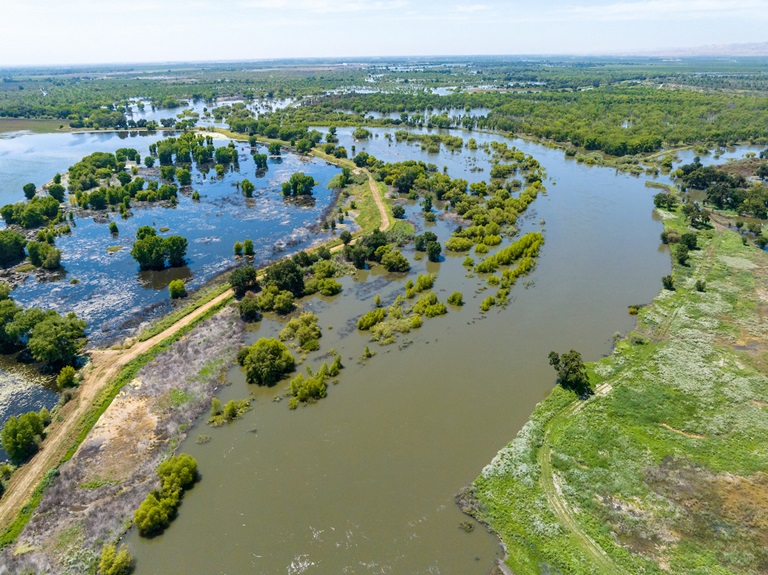
California is taking a new, data-driven approach to capturing floodwaters for groundwater recharge. The Department of Water Resources (DWR), in coordination with GEI Consultants, has released the Central Valley Flood-MAR Dashboard for public testing, allowing water managers across the San Joaquin and Sacramento Valleys the opportunity to explore the tool and offer feedback.
Dashboard Overview
In response to Governor Newsom’s California Water Supply Strategy: Adapting to a Hotter, Drier Future, DWR is providing regulatory and technical assistance to groundwater sustainability agencies (GSAs) and other local public agencies to increase the pace and scale of groundwater recharge and support long-term groundwater management for sustainability and resilience.
Diversion in 2023, which were permitted under Executive Orders N-4-23 and N-7-23 as well as California Water Code §1242.1, highlighted the need for increased system-wide coordination to maximize potential recharge. In response, this dashboard brings together statewide forecasts and local flood information to help identify when and where excess water may be available and how it can be safely managed. The dashboard was created to serve two primary functions:
- To help water agencies and diverters track floods and forecasts in one place, making it easier to identify when and where floodwaters can be safely diverted for groundwater recharge within the Central Valley.
- To support flood management and flood emergency response by providing timely flood conditions and forecast information to decision-makers.
The dashboard also serves as a secondary means of public notification of flood threat under California Water Code §1242.1.
Identifying Flood Conditions
Flood conditions are displayed in the dashboard through two indicators: channel cross sections and local flood threshold points.
Cross sections are the main indicator to help facilitate diversions. Each cross section displays local flood information and approximate current conditions. Cross sections are developed using the latest LIDAR data from the Central Valley Floodplain Evaluation and Delineation (CVFED) 2.0 model and the current conditions are calculated based on flow from the nearest California Data Exchange Center (CDEC) station.
Where data gaps exist, local flood threshold points display identified local flood thresholds, flood jurisdictional authority, and diversion eligibility.
Once the responsible agency confirms that the public has been notified, the dashboard highlights the reaches of the river where diversions can occur.
Additional key features and datasets available through the dashboard include:
- Delta daily operations summary
- Groundwater recharge suitability indices
- FEMA Flood Zones
- Locations of points of diversion
- Equipment/material resource locations
- Contact information for pertinent flood management and emergency operations agencies
- And more!
Testing and Feedback Submittal
The Flood-MAR Dashboard is available for testing through March 31, 2026. DWR invites feedback from local agencies, water managers, diverters, and other interested parties to help improve the dashboard's functionality, data accuracy, and user experience.
Feedback and comments may be submitted at CVdashboardhelp@geiconsultants.com or through the dashboard using the “Contact Us” function.