
Lake Oroville Update - January 16, 2026
A drone view of Oroville Dam and main spillway at Lake Oroville in Butte County, California. Photo taken January 8, 2026.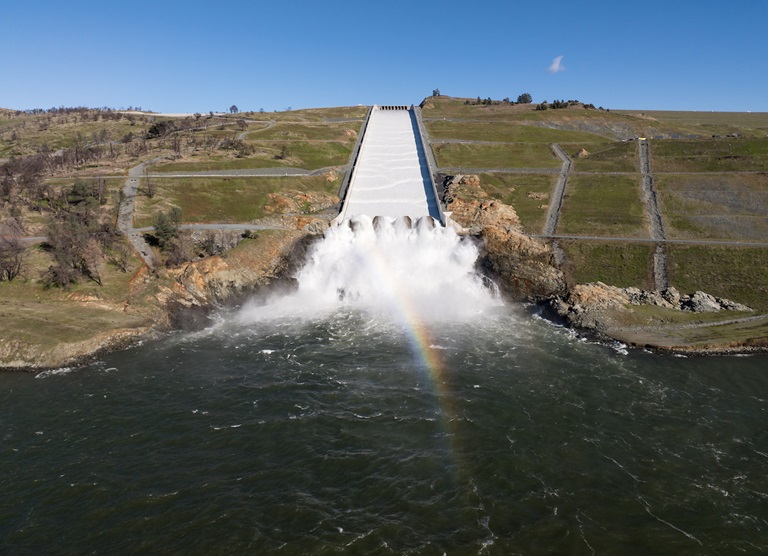
Flood Control Releases Ongoing from Lake Oroville
The Department of Water Resources (DWR) continues required flood control releases using Oroville Dam’s main spillway. With reduced runoff into Lake Oroville and current dry conditions, DWR is reducing outflows for storage benefits while continuing to meet federal guidelines for downstream flood protection.
Between mid-September and May, DWR is required to operate Lake Oroville for flood control under federal Water Control Manual Guidelines set by the U.S. Army Corps of Engineers. These federal regulations establish a set storage space that is reserved to capture inflows from rain and future snowmelt, while protecting downstream communities from damaging flood events through coordinated releases. To maintain this storage space, DWR conducts flood protection releases from Lake Oroville. Some of the water released from Oroville for flood control is captured downstream for beneficial uses by local landowners, communities, and the State Water Project.
Releases to the Feather River are coordinated closely with the U.S. Army Corps of Engineers and other downstream water operators. Feather River recreational users are advised to remain alert as river flows are expected to be swift and cold and may change based on projected weather forecasts.
The information below reflects current reservoir level estimates. Forecasts can change quickly and may affect the estimates provided.
- Current Oroville Reservoir Level: 850 feet elevation
- Current Storage: 79 percent of capacity
- Total Releases to the Feather River: 5,100 cubic feet per second (cfs); decreasing to 3,000 cfs on Monday, Jan. 19
The Lake Oroville reservoir is the largest storage facility in the State Water Project, providing flood protection while supporting environmental and water delivery needs to 27 million Californians. DWR continues to monitor lake levels, weather forecasts, and mountain snow levels to optimize water storage while allowing for carryover storage into next year.
Snow Goose Festival
Celebrate one of the greatest migratory bird pathways in the world at the Snow Goose Festival of the Pacific Flyway happening Jan. 22-25. The festival features a variety of activities throughout the four-day event, including guided field trips to view the waterfowl, raptors, and Snow Geese that migrate through the Northern Sacramento Valley during the winter months.
DWR’s Lake Oroville Visitor Center Guides will host a free educational booth featuring kids’ activities between 9 a.m. and 3 p.m. on Saturday, Jan. 24 and Sunday, Jan. 25 at the Patrick Ranch Museum in Durham. Join festival attendees with visits to the Thermalito Forebay and Afterbay, and Oroville Wildlife Area offering possible sightings of rough-legged hawks, ferruginous hawks, merlin, bald eagles, golden eagles, red-tailed hawks, burrowing owls, ducks, grebes, and other deep-water birds. Check out the Snow Goose Festival website for more details about activities, an avian art exhibit, and guided field trips during the four-day event.
Midwinter Bald Eagle Survey
Environmental scientists from DWR and the California Department of Fish and Wildlife (CDFW) participated in the National Midwinter Bald Eagle Survey in early January. This nationwide effort, coordinated by the U.S. Army Corps of Engineers, aims to determine bald eagle distribution and identify areas of important winter habitats. This year’s official count recorded was 44 bald eagles for the Lake Oroville Winter Roost and eight at the Thermalito Complex.
Lake Oroville and the Sacramento Valley area provide an ideal habitat for bald eagles. Fish and waterfowl are the eagle’s main food source during this time of the year, and large water bodies like Lake Oroville provide a wide variety of fish while the nearby wetlands and flooded rice fields provide an abundant supply of waterfowl for eagle foraging. The many trees and snags (tall dead trees) near water area offer prime roosting locations for the bald eagles that migrate to and through the area during the winter months.
Golden Mussel Inspection Program
DWR is reminding the public that boat ramps at Lake Oroville are no longer open 24/7. Watercraft must be out of the water by ramp closing time or they will be locked into the facility overnight. Please plan ahead. More details about DWR’s mussel inspection program are available at water.ca.gov/mussels.
Watercraft Inspection Location/Decontamination Services
North Thermalito Forebay at Garden Drive and HWY 70 in Oroville
Hours of operation: Daily from 8:30 a.m. to 4:30 p.m.
Sealed Vessel Launching
Lake Oroville
Ramp hours: Daily from 7:30 a.m. to 6:30 p.m.
- Spillway
Ramp hours: Monday-Thursday 7:30 a.m. to 6:30 p.m.; Friday-Sunday 7:30 a.m. to 8 p.m.
- Bidwell Canyon
Ramp hours: Monday-Thursday 5 a.m. to 6:30 p.m.; Friday-Sunday 5 a.m. to 8 p.m.
- Lime Saddle
Ramp hours: Daily from 5 a.m. to 6:30 p.m.
- Loafer Creek/Loafer Point
Thermalito Afterbay
Ramp hours: Daily from 1.5 hours before sunrise to 1 hour after sunset
- Monument Hill
Thermalito Forebay
Ramp Hours: Daily from 8 a.m. to sunset
- North Forebay (Non-motorized vessels only)
Feather River Fish Monitoring Station
With ongoing fluctuations in river flows due to required flood control releases from Oroville Dam, DWR has suspended operations of the Feather River fish monitoring station. Operation of the monitoring weir is expected to resume in early March to coincide with the return of spring-run Chinook salmon. To see fish count data from previous years, visit CalFish.org.
Current Lake Operations
Lake Oroville is at 850 feet elevation and storage is approximately 2.71 million acre-feet (MAF), which is 79 percent of its total capacity and 139 percent of the historical average.
Feather River flows are at 650 cfs through the City of Oroville with 4,450 cfs being released from the Thermalito Afterbay River Outlet for a total Feather River release of 5,100 cfs downstream. Through the weekend, releases from the Outlet will be reduced, reaching 2,350 cfs on Monday, Jan. 19 for a total Feather River release of 3,000 cfs. DWR continues to assess Feather River releases daily.
The public can track precipitation, snow, reservoir levels, and more at the California Data Exchange Center. The Lake Oroville gage station is identified as “ORO.”
All data as of 11:59 p.m. on 1/15/2026.