
How the State Water Project Used Adaptive Management to Capture More Water During Recent Storms
Clifton Court Forebay, which is located two miles upstream of the Banks Pumping Plant in Contra Costa County, California. The Forebay is located on the southwestern edge of the Sacramento-San Joaquin Delta in Contra Costa County. Photo taken on October 30, 2025.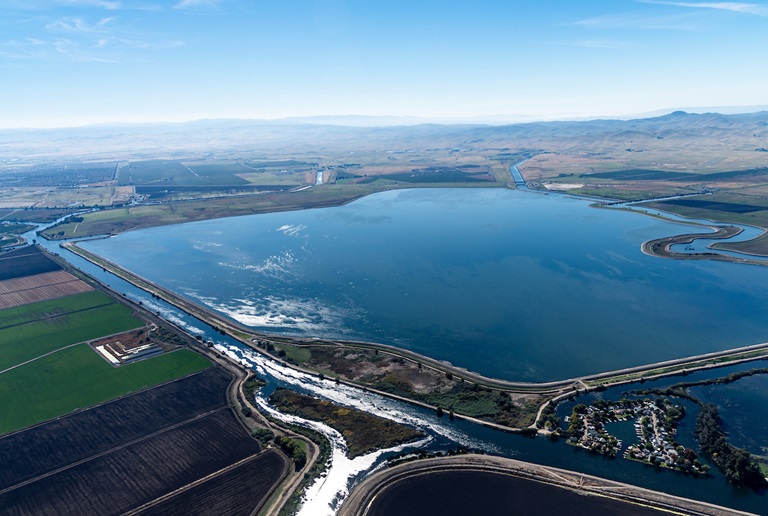
As runoff from the last sizable storm was rolling down California rivers to San Francisco Bay in December, operators of the State Water Project used scientific information and modeling about the movement of fish species in the Sacramento-San Joaquin Delta to adjust operations and capture additional water supply without compromising species protections.
Flexibility in the project’s Incidental Take Permit (ITP), plus tight coordination with the California Department of Fish and Wildlife (CDFW), allowed for a modest boost in State Water Project storage. Such flexibility is increasingly important in an era of weather whiplash. Long stretches of dry days frequently follow big storms, as happened in January.
Operation of the State Water Project during the storm that began in mid-December illustrates how the California Department of Water Resources (DWR) managed adaptively, in coordination with regulators, to balance protection of endangered species and water supply for 27 million Californians. It demonstrates the usefulness of cutting-edge science and the importance of coordination among agency scientists.
DWR’s ITP calls for the State Water Project to ramp down pumping during the first big storms of the season. Otherwise known as the “first flush” period, monitoring data shows that this is the time when endangered species such as Chinook salmon move downstream to the ocean or when endangered sturgeon and smelt species migrate to upstream spawning grounds. In either case, fish risk being salvaged or killed if they move into south Delta channels near the State Water Project pumping plant.
When the mid-December storm arrived, DWR scientists evaluated risk for fish at the pumps using real-time monitoring information and prediction models. During the “first flush” event, DWR scientists hypothesized that fish salvage at the pumps would decrease as river flows to the Delta increased. Subsequently, DWR proposed a modification to the “first flush” action to CDFW, requesting additional water supply exports as river flows increased to high levels. CDFW approved the operations plan.
When spring-run were salvaged, pumping was dialed back. Once the spring-run moved out of the area, pumping was ramped back up and there was no further salvage of endangered species at the pumps. Real-time data showed that few species were present in the Delta at this time.
This exercise of real-time flexibility reduced overall Delta outflow by about one percent and gained 15,000 acre-feet of water supply for the State Water Project, roughly enough to supply 45,000 homes for a year.
The experience reinforced that capturing additional water supply during high outflow periods when there are minimal risks to species is good water management.