
Lake Oroville Update- February 6, 2026
CDFW staff use a long pipe to plant steelhead trout in Mile Long Pond at the Oroville Wildlife Area. 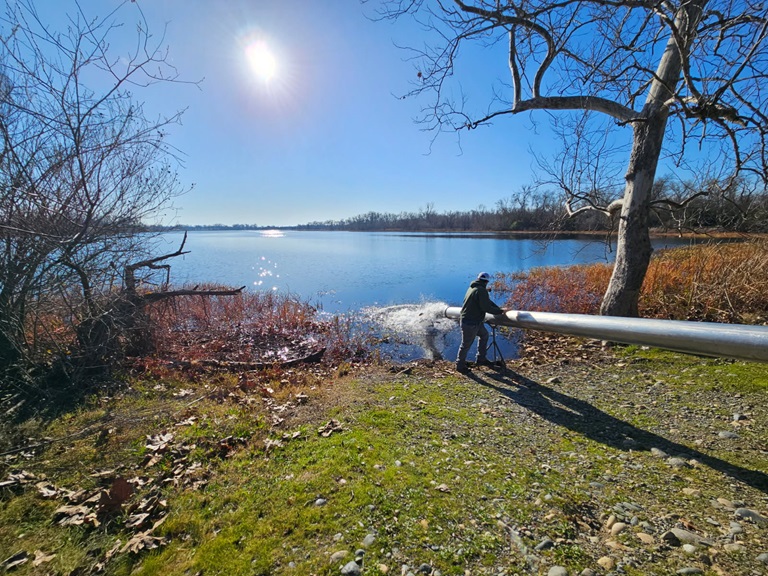
DWR Maintaining Oroville Releases
The Department of Water Resources (DWR) is maintaining water releases from Oroville Dam to combat salinity intrusion in the Delta. As part of DWR’s water rights permit for the State Water Project, low-salinity zones must be maintained February through June to protect critical habitat for native fish. DWR continues to conserve as much water as possible while continuing to meet federal guidelines for downstream flood protection and state environmental regulations.
Between mid-September and June, DWR is required to operate Lake Oroville for flood control under federal Water Control Manual Guidelines set by the U.S. Army Corps of Engineers. These federal regulations establish a set storage space that is reserved to capture inflows from rain and future snowmelt, while protecting downstream communities from damaging flood events through coordinated releases. To maintain this storage space, DWR conducts flood protection releases from Lake Oroville. Some of the water released from Oroville for flood control is captured downstream for beneficial uses by local landowners, communities, and the State Water Project. Releases from Oroville Dam also support Feather River habitat for salmon, steelhead, sturgeon, and other river species.
Releases to the Feather River are coordinated closely with the U.S. Army Corps of Engineers and other downstream water operators. Feather River recreational users are advised to remain alert as river flows may change based on projected weather forecasts.
The information below reflects current reservoir level estimates. Forecasts can change quickly and may affect the estimates provided.
- Current Oroville Reservoir Level: 856 feet elevation
- Current Storage: 81 percent of capacity
- Total Releases to the Feather River: 8,000 cubic feet per second (cfs)
The Lake Oroville reservoir is the largest storage facility in the State Water Project, providing flood protection while supporting environmental and water delivery needs to 27 million Californians. DWR continues to monitor lake levels, weather forecasts, and mountain snow levels to optimize water storage while allowing for carryover storage into the following year.
Feather River Fish Hatchery Fish Planting
The California Department of Fish and Wildlife (CDFW) released approximately 1,886,600 fall-run Chinook salmon fry at approximately 1.4 inches each into the Feather River at the Oroville Wildlife Area Thermalito Afterbay Outlet boat ramp in January. The fall-run Chinook salmon were reared at the Feather River Fish Hatchery, which supports Central Valley Chinook salmon and steelhead populations.
In addition, CDFW planted Central Valley yearling steelhead at sites along the Feather and Sacramento rivers between January 6-27, 2026. Approximately 575,185 yearling-size steelhead were raised in 2025 for release in local waterways, averaging approximately 10-inches in length.
- Feather River at Boyd’s Pump Boat Launch
- Sacramento River at Verona Boat Launch: 117,715
- Thermalito Afterbay at Wilbur Road Boat Launch: 74,460
- *NEW LOCATION: Oroville Wildlife Area at Mile Long Pond: 6,370
Thanks to a surplus of healthy steelhead yearlings at the Hatchery, CDFW planted steelhead at a new location this year, Mile Long Pond (accessible from the Vance Ave. entrance) in the Oroville Wildlife Area, extending cold-water fishing opportunities beyond the river and Thermalito Afterbay. Future stocking opportunities depend on annual hatchery conditions and cannot be guaranteed each year.
The Feather River Fish Hatchery is a California State Water Project (SWP) facility built in the late 1960s by DWR to mitigate impacts on fish migration resulting from the construction of Oroville Dam. DWR owns and maintains the facility and provides funding to CDFW to perform spawning, rearing, and stocking operations.
Oroville Recreation Advisory Committee
The Oroville Recreation Advisory Committee (ORAC) met Feb. 6 at the Oroville Southside Community Center. ORAC was established by the Federal Energy Regulatory Commission (FERC) to review and provide recreation plan recommendations for Oroville Facilities owned by DWR. The 13-member committee is made up of representatives from state and local government, recreation groups, and business and community organizations. To obtain a summary of the meeting, send a request to oroville@water.ca.gov.
Golden Mussel Inspection Program
DWR is reminding the public that boat ramps at Lake Oroville are no longer open 24/7. Watercraft must be out of the water by ramp closing time or they will be locked into the facility overnight. Please plan ahead. More details about DWR’s mussel inspection program are available at water.ca.gov/mussels.
Watercraft Inspection Location/Decontamination Services
North Thermalito Forebay at Garden Drive and HWY 70 in Oroville
Hours of operation: Daily from 8:30 a.m. to 4:30 p.m.
Starting March 8: Daily from 8:30 a.m. to 5:30 p.m.
Sealed Vessel Launching
Lake Oroville
Ramp hours: Daily from 7:30 a.m. to 6:30 p.m.
Starting March 8: Daily from 7:30 a.m. to 9 p.m.
- Spillway
Ramp hours: Monday-Thursday 7:30 a.m. to 6:30 p.m.; Friday-Sunday 7:30 a.m. to 8 p.m.
Starting March 8: Daily from 7:30 a.m. to 9 p.m.
- Bidwell Canyon
Ramp hours: Monday-Thursday 5 a.m. to 6:30 p.m.; Friday-Sunday 5 a.m. to 8 p.m.
Starting March 8: Daily from 5 a.m. to 9 p.m.
- Lime Saddle
Ramp hours: Daily from 5 a.m. to 6:30 p.m.
Starting March 8: Daily from 5 a.m. to 9 p.m.
- Loafer Creek/Loafer Point
Thermalito Afterbay
Ramp hours: Daily from 1.5 hours before sunrise to 1 hour after sunset
- Monument Hill
Thermalito Forebay
Ramp Hours: Daily from 8 a.m. to sunset
- North Forebay (Non-motorized vessels only)
Current Lake Operations
Lake Oroville is at 856 feet elevation and storage is approximately 2.79 million acre-feet (MAF), which is 81 percent of its total capacity and 134 percent of the historical average.
Feather River flows are at 650 cfs through the City of Oroville with releases from the Thermalito Afterbay River Outlet at 7,350 cfs for a total Feather River release of 8,000 cfs downstream. DWR continues to assess Feather River releases daily.
The public can track precipitation, snow, reservoir levels, and more at the California Data Exchange Center. The Lake Oroville gage station is identified as “ORO.”
All data as of 11:59 p.m. on 2/5/2026.