
DWR Partners with Agencies to Untangle Mystery of California's Harmful Algal Blooms
Amelia Ayers, a Physical Scientist with the U.S. Geological Survey, packs up gear used to gather shellfish samples collected at Martinez Harbor, Contra Costa County. 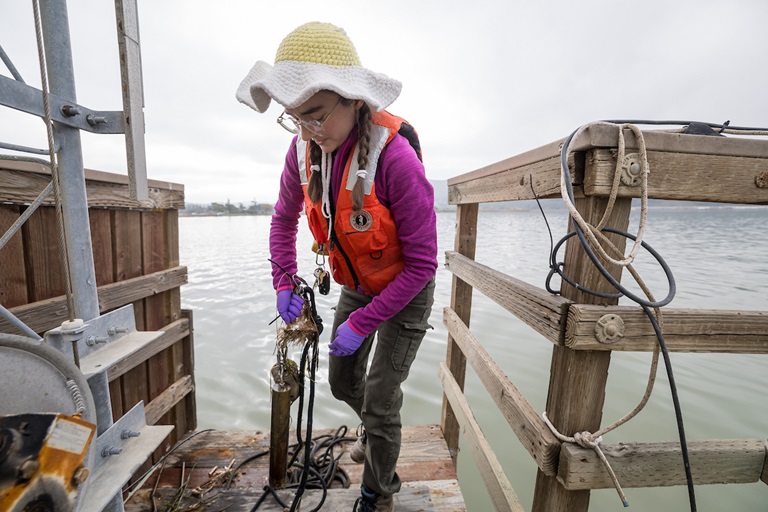
Appearing like something out of science fiction, harmful algal blooms (HABs) can form thick mats that accumulate on freshwater surfaces throughout California. Most common during the summer, HABs are a nuisance that can smother entire portions of waterways, sucking oxygen from the system as they decompose, while producing toxins which can be dangerous to humans and pets.
DWR is addressing the issue by drawing on its own expertise and that of partner agencies to better understand the drivers and dynamics of HABs. DWR is in the midst of a five-year, $3 million research project by the National Oceanic and Atmospheric Administration (NOAA) National Centers for Coastal Ocean Science’s Monitoring and Event Response for Harmful Algal Blooms program, or MERHAB, with the aim of developing a HAB monitoring program for the Bay-Delta estuary.
“HABs have emerged as priority management issues in the Bay and the Delta in recent years,” said David Senn, director of the San Francisco Estuary Institute’s (SFEI) Clean Water Program and co-lead investigator. “The NOAA MERHAB project is allowing us to make some of the necessary investments into HAB monitoring program development.”
Co-lead by scientists at DWR, SFEI, and the U.S. Geological Survey, the research project is focused on investigating HABs in the Bay-Delta and building an estuary-wide management strategy for HABs. It’s a tall order, especially in the largest estuary on the west coast of North America, a vast and complicated region.
“Hydrologically complex and large waterbodies are particularly difficult to manage with respect to HABs,” said Ellen Preece, environmental program manager with DWR. “It is expensive and requires ongoing management. There is not a single one-time fix.”
The project team includes scientists from the University of California, Santa Cruz, Bend Genetics, San Francisco Baykeeper, Restore the Delta, Central Valley and San Francisco Bay Regional Water Quality Control Boards, and Cal Poly Maritime Academy, working closely with regulators, managers, and non-governmental organizations.
Together, the team employs a coordinated monitoring program that gathers the type of data needed to help detect HAB events and understand their causes.
An Emerging Problem
While HABs are natural phenomena that have been occurring for millennia, there have been notable increases in their global frequency and severity during recent decades – making them a priority water quality management issue in the Sacramento-San Joaquin Delta and San Francisco Bay.
Rarely observed in the Delta prior to 2000, major HAB events have become a frequent occurrence during the last 20 years in various parts of the Delta, including the Stockton area, and Discovery Bay. While less common and slower growing in the chill of winter, HABs show up in force during the spring and summer amid conditions that fuel their growth – warm, stagnant water and a continual source of nutrients.
The 2022 multi-week occurrence of HABs in the San Francisco Bay caused widespread fish mortality, alarming scientists and the public. This event put HABs on the map as an important management issue in the region that required better understanding to inform decision-makers.
Putting HABs Under the Microscope
Scientists are deploying novel investigative methods such as scanning, searching, and sampling throughout the Bay-Delta region to uncover the likelihood of HAB development and adverse effects.
Remote sensing technology can be used to track HABs, as their distinct pigments are easy to detect. However, this isn’t a one-size-fits-all detection method as HABs often appear on small Delta side channels undetected by current remote sensing tools. As part of this project, scientists are also developing improved remote sensing algorithms for the Bay-Delta to improve detection of HABs.
Scientists are also interested in learning more about the movement of HABs and associated toxins. That’s being revealed with tools such as continuous data monitoring stations in central San Francisco Bay, laboratory findings, and relying on community scientist volunteers who observe blooms and take samples. The collected data is helping to fill knowledge gaps about how algal cells and their toxins move from the Delta to the Bay.
“When HABs spread throughout San Francisco Bay in 2022 and 2023, the discolored water and subsequent fish kills were first reported to Baykeeper's pollution hotline by community members,” said Jon Rosenfield, Baykeeper’s science director. “Every day, community members represent millions of eyes on the Bay, especially in shallow shoreline areas where blooms are likely to start and which more advanced monitoring systems have difficulty reaching.”
Building on this proven role, the MERHAB project is partnering with Baykeeper to recruit and train community science volunteers using established NOAA Phytoplankton Monitoring Network methods. This effort helps provide early warning of shoreline HABs, assess whether monitoring needs to be expanded along shoreline habitats, and informs best practices for long-term community science programs in San Francisco Bay.
What’s Next
The MERHAB project features the eventual creation of a dashboard that will serve as a one-stop shop for the public to access the latest monitoring data and to contribute updated information. This resource will also provide water managers with a decision-support tool for HAB mitigation.
“The goal we have with the MERHAB project is to identify and develop the types of monitoring and monitoring program that will provide the necessary information to inform management,” said Senn.
Preece agreed, noting that while the focus is not necessarily on mitigation, the coordinated monitoring program could be used to inform future mitigation decisions.
To see the project team in action, check out the collection of water sampling photos on DWR’s Pixel gallery.